How could laymen — men without formal authority, men who did not wear the robes of the priestly class — speak with such confidence, such clarity, and such authority?
Disturbance and Perplexity — Giving way to shared allegiance
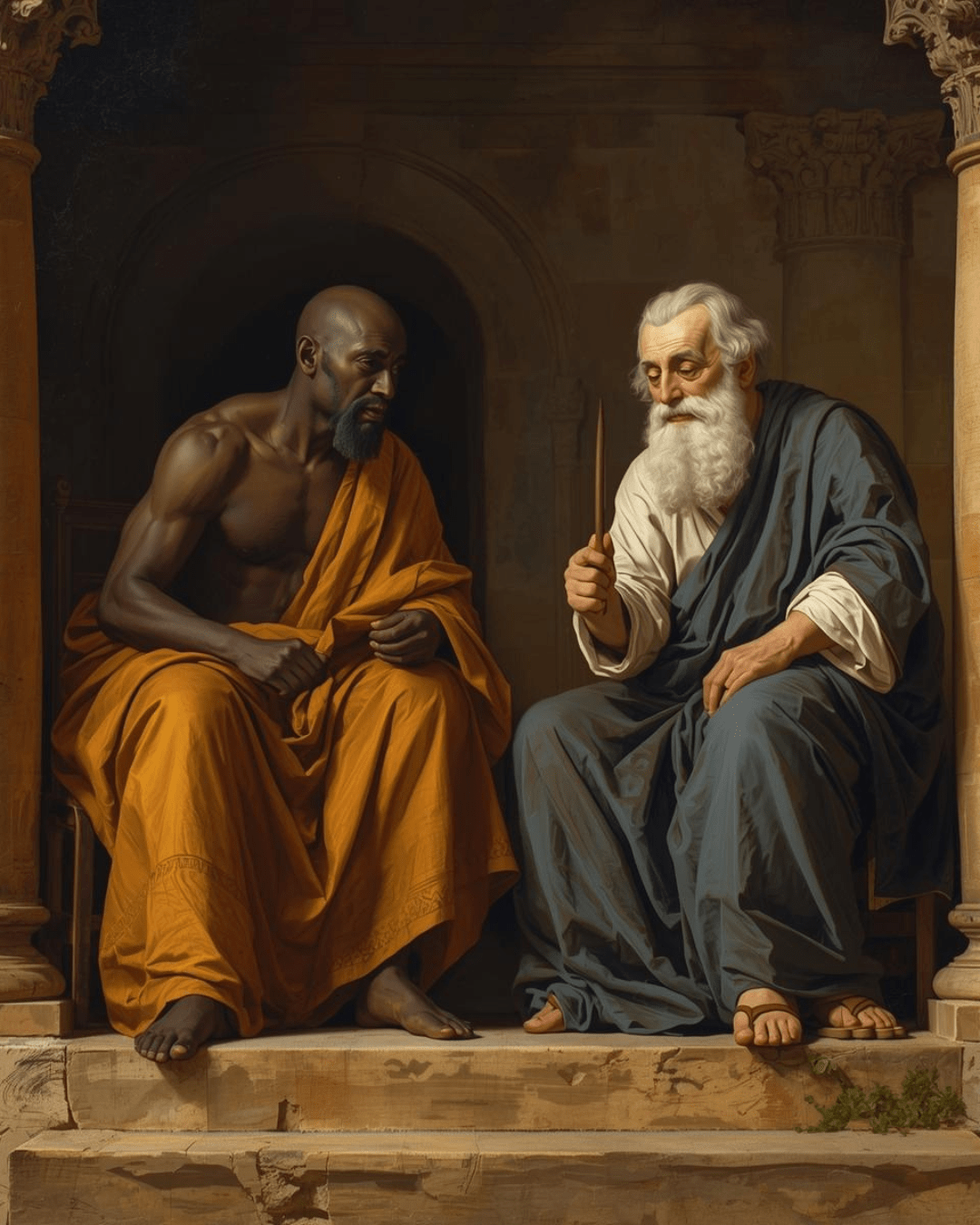
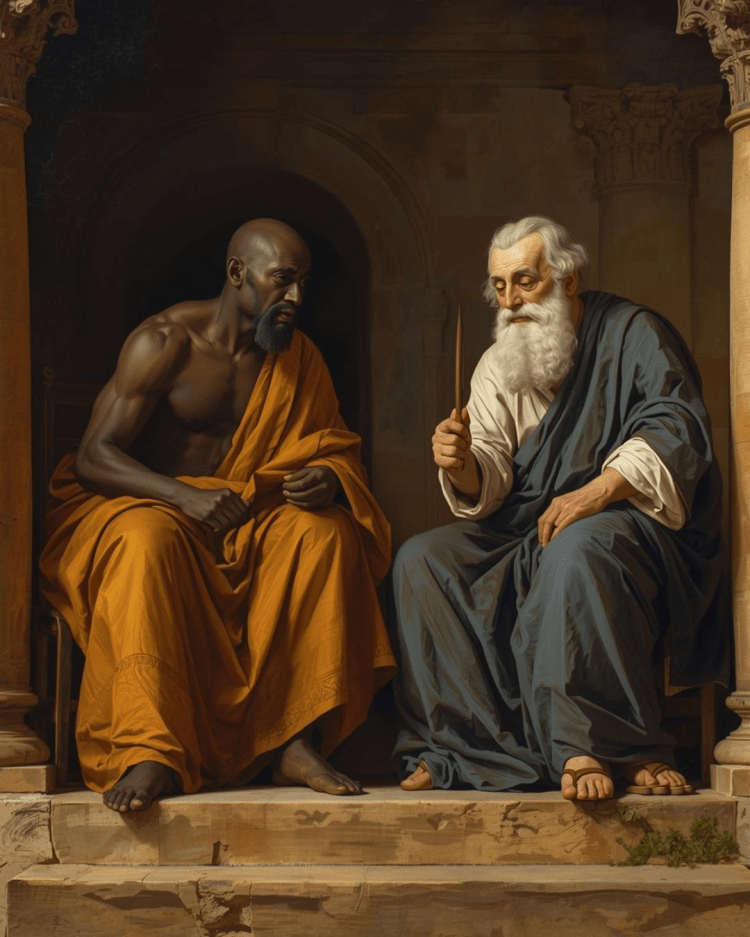
In the order of the Temple, Peter and John were supposed to be followers, not teachers, servants, not leaders. Yet the crowd treated them as witnesses to something greater than any institutional power.
What perplexed the ruling class was not simply how the crippled one now walked. It was the claim that this miracle revealed the fulfillment of messianic prophecy — a fulfillment that seemed to inaugurate a new kind of authority, grounded not in rank, or hierarchy, but in a living encounter with Christ: the Bride belonging to the Bridegroom, as testified by John.
In the logic of the authorities, if John had lost his head, had he truly died? How could he now be seated here with Peter — filled with the Holy Spirit, full of ancient memory, wisdom and authority?
Greatly disturbed they had Peter and John taken into custody overnight.
“What shall we do with these men?” they asked. It is clear to everyone living in Jerusalem that a remarkable miracle has occurred through them, and we cannot deny it. But to keep this message from spreading any further among the people, we must warn them not to speak to anyone in this name.” (Acts 4: 16-17)
Yet the message spread anyway. This was no mere act of charity — five thousand people were fired up even as the authorities tried to silence it. Was this merely the rumour of the grapevine, or a faithful allegiance to the authorship of the Holy Spirit?
And so the authorities and those in their allegiance remained perplexed:
“…They could not find a way to punish them, because all the people were glorifying God for what had happened. For the man who was miraculously healed was over forty years old.” (Acts 4: 21:22)
Truly this was — and is — the Crux of the Matter.
How could this Healed Crippled One, be the crucified one? Was not Jesus the Crucified One, under forty years old pinned to the Cross — to the Amygdala the prophets declared the Lord was watching over? (Jeremiah 1:11-12)
This is the fifth in a series of Epiphany reflections. Epiphany VI, turns to the Crux of the Matter: how the forty-year-old Crippled One is brought into public view as the Crucified Bride — when Peter takes her hand —a truth the authorities want to keep sacred.
If you would like to receive the next reflection, be sure to subscribe here.
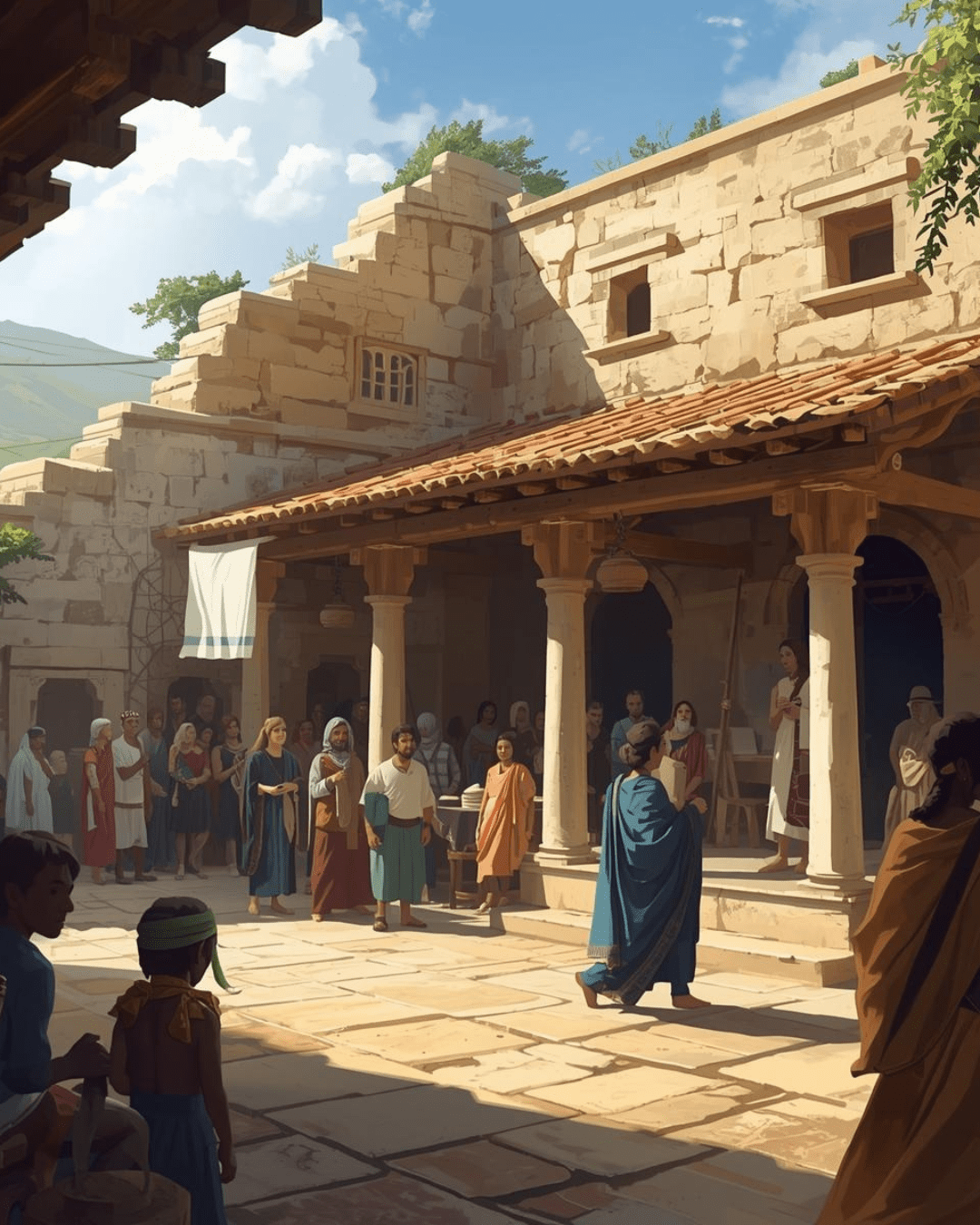
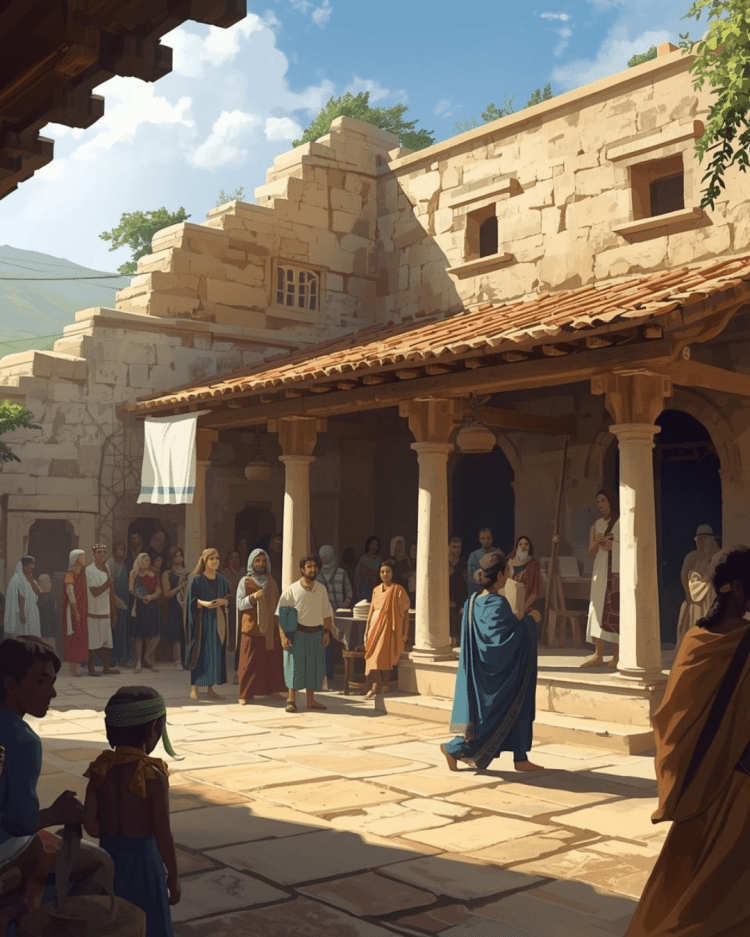
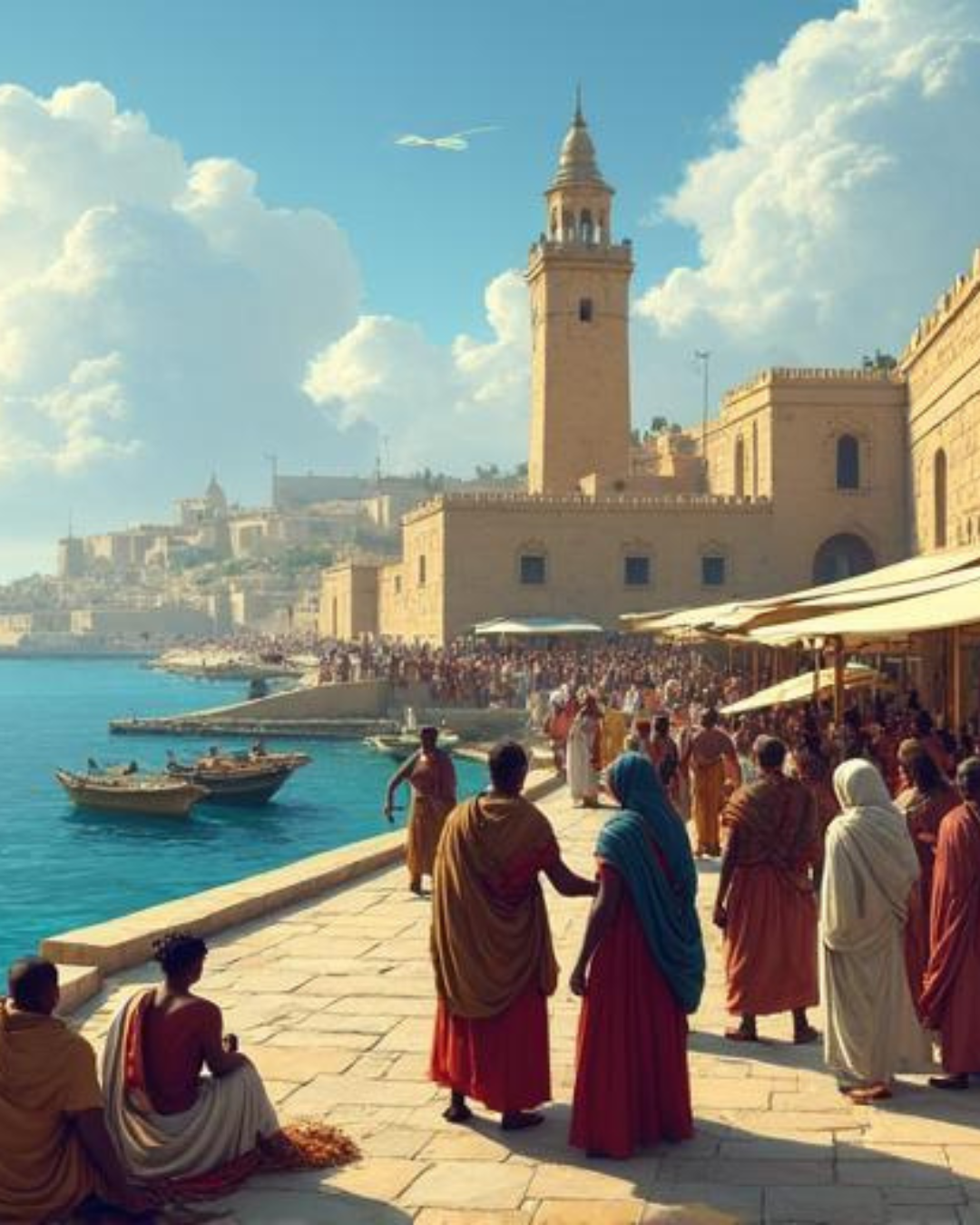
The crowd gathers at Solomon’s porch as February’s winter light lingers on the stone — like a rose blooming out of season, clinging still to the hope of spring, presenting what has waited through eons to bloom more beautiful.
Encountering Ancient Love at Solomon’s Colonnade
As the crowd swells around this unexpected bloom — the restoration of a crippled one — Peter steps forward to make one thing clear: this Crippled One did not walk and flower from his power or John’s alone. Rather, the moment cannot be understood apart from an ancient love that had been alive for centuries — wounded by dishonesty and disbelief, but never extinguished.
Those who have long awaited this moment are ready for Peter’s words. They hear him echo John the Forerunner — calling them to repent and remember — so that their transgressions may be forgiven, and the Crippled One — appearing like a rose in winter — may be restored as the very foundation stone.
First came the Johannine Teacher — like a father of Eros — speaking to her under the cover of darkness, awakening the Love she had carried in her soul since the songs of Solomon and long before — as the Gardener of the fig tree.
Then in the same town of Andrew and Peter, when Phillip found Nathanael — a true Israelite — her thorned branches began to bud and bloom like a flower in winter, watching, and waiting for the Gift of God who would one day take her hand and redeem her in public.
As you listen to Peter’s speech, notice that Scripture speaks in male grammar, yet the mystery revealed is not only masculine. When Peter says “He,” listen for what has long been assumed, and also listen for the whole Christ — Bride and Bridegroom together — standing fully alive at the heart of this moment, as testified and witnessed by the Johannine Forerunner.
“Why do you stare at us, as though by our power we had made this person walk? The God of Abraham, Isaac, and Jacob…has glorified his servant Jesus…” (Acts 3:12-13)
“Repent therefore, and turn back, so that your sins may be wiped out, so that times of refreshing may come from the presence of the Lord…” (Acts 3:19-20)
“…whom heaven must receive until the time for restoring all things, as God spoke long ago through the prophets.” (Acts 3:21)
Heaven cannot be understood simply as a spiritual, bodiless realm. It is better seen as a treasury of holy memory where God’s ancient love is preserved — publicly in Scripture, in prayer, and in the hearts of believers — until the living Christ: the Bride and Bridegroom together is recognized face to face in the fullness of time, as the Johannine Forerunner testified.
_____________________________________________
This is the fourth in a series of Epiphany reflections. Epiphany V, turns to what the authorities make of this amazing moment.
If you would like to receive the next reflection, be sure to subscribe.
At Solomon’s Porch, Peter takes the hand of a person described as crippled from birth — one who cannot yet walk the talk. As with any newborn, the lack is not desire but power: power in the limbs, power to communicate. Newly born into life, such a one appears as a beggar.
Why the Porch?
A woman pledged in marriage yet not taken, not yet redeemed, bears the promise of life, yet cannot bring forth the family she hopes for without a willing bridegroom to take her hand in a public way.
For centuries, readers have assumed this cripple was male and dependent on charity — mistaking expectancy for a plea for money. Yet those watching, alert to John’s testimony, see Peter draw attention to himself and to John, and they are rewarded. In this act the promise takes place: the Bride belonging to the Bridegroom steps into public life, as Peter takes her and and she clings to him — and to John — just as John the Forerunner had testified. (John 3:28-29; John 20:17
It is in this same light that the Teacher’s words to Mary after the resurrection must be heard. “Do not cling to me” does not deny that she is the Bride of the promise: it clarifies that the Teacher is not the Bridegroom she and many others had supposed. In that moment, words spoken long before — “cling to the Lord” and “If you knew the gift of God” — dry her tears and remove the scales of a shared dishonesty that had blinded her eyes. (Proverbs 16:11) Thus her feet are quickened, so she can honestly go and live the promise. (John 20:17; John 4:10; John 1:47)
The female gender of this crippled man, this person, matters. Women have been historically crippled by male grammar and by the way the Cross has been publicly interpreted — narrowing who Jesus Christ of Nazareth is perceived to be.
Yet the prophet Isaiah spoke of a Branch, the coming Messiah, who would save and preserve a remnant from the house of Israel. The Hebrew word netzer means branch or shoot, and it echoes the name Nazareth — and in the title Nazarene. Scripture pins Jesus to the branch of a tree. And the prophet Jeremiah sees this branch as an amygdala, affirmed by the Lord’s own words: “I am watching over my word to accomplish it.” (Jeremiah 1:12)
So pinned to the Branch, the Amygdala, was seen by many as a scandal, a public offence. Yet Mary stood by the Cross, and other women have stood by her, waiting upon the Word of the Lord to be fulfilled. (John 19:25)
And so the amazed followed Peter and John — and the one clinging to Peter’s hand — into Solomon’s Colonnade, to hear Peter speak on the porch.
Blessed are those who fear the Lord and walk in his ways. You will eat the fruit of your labour; blessing and prosperity will be yours. Your wife will be like a fruitful vine in your house, your sons like olive shoots around your table. (Psalm 128:1-3)
This is the third of a series of Epiphany blog posts. Epiphany IV follows the crowd as they listen to Peter speak.
The last blog post, ended with light that blinds and cripples. Scripture does not shy away from this kind of confusion.
Jesus the Gate: Beauty Recognized
In the Pauline Author’s first letter to the Churches in Corinth, people were confused. Some were aligning themselves with Cephas, some with Apollos, others with Paul, and others still with Christ. Some may even have supposed that John the Baptist was the Christ — and that Paul, therefore was someone who also baptized (1Corinthians 1:11-13).
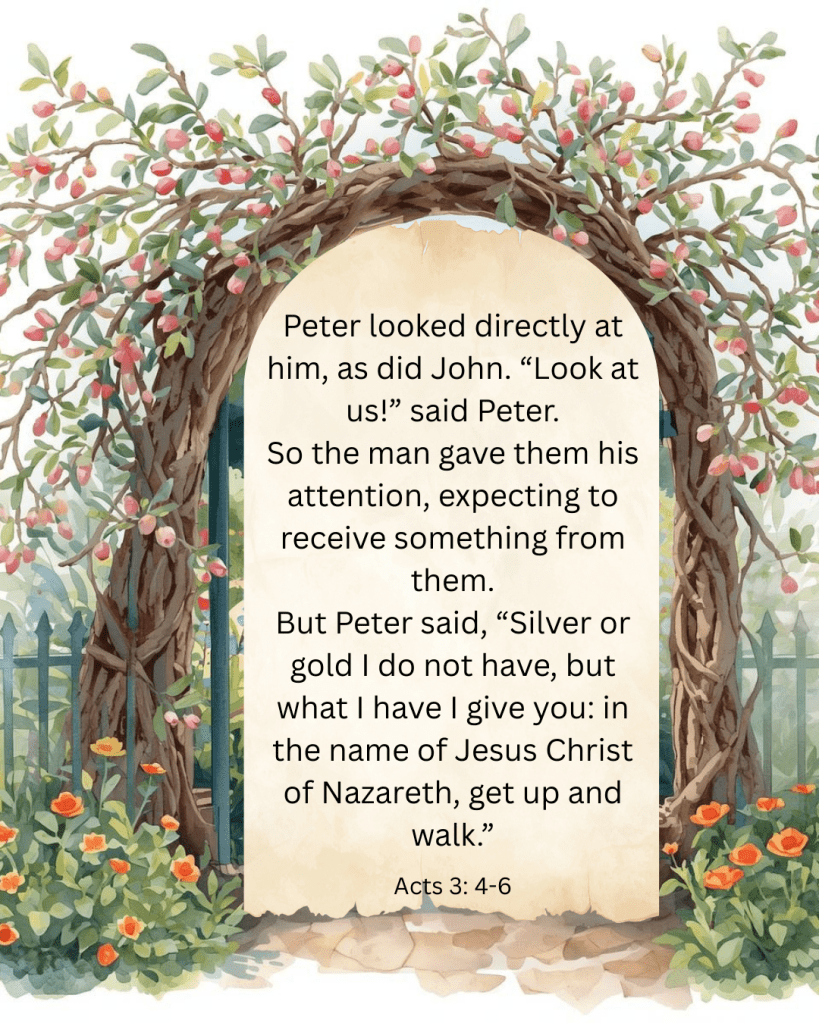
When Simon — called Cephas by some and Peter by others — stood with John in front of the Gate called Beautiful, they encountered a man who had been crippled from birth (Acts 3:1-6).
The season of Epiphany opens with the Baptism of Jesus in the Jordan by John, following the Holy Family’s journey to Egypt. Tradition remembers this journey led them to Alexander’s place or city—a formative setting shaped by dialogue, debate, and the practices of rhetoric and allegory within Greek and Roman culture
Might a place remembered as the nativity of Apollos be such a place—where Mary and Joseph’s marriage blossomed, and where a magnificent Light, born of their love and witness, began to testify to an eternal love for God and neighbour?
A man crippled from birth sits outside the Gate. The Pauline and Apolline witness to Jesus Christ — the Light born of Mary and Joseph’s marriage — has come into view, but its meaning has not yet taken root. Like all of us at birth, babies do not yet know how to walk and may reach out to shiny things to help them stand. So too, a young disciple of Jesus may see charity in the form of gold and silver — as if the keys to the kingdom Peter holds were made of gold and silver.
But parents and extended family members know when to let a child reach for shiny things — and when to draw them gently out of the way. What first steadies our crippled infant bodies cannot teach us how to walk. Standing is learned by watching, listening, and trusting the voices of those who have already learned to stand.
Peter gives what he has — in the name of Jesus Christ of Nazareth
Taking him by the right hand, Peter helped him up, and at once the man’s feet and ankles were made strong. He sprang to his feet and began to walk. Then he went with them into the temple courts, walking and leaping and praising God.…
When all the people saw him walking and praising God, they recognized him as the man who used to sit begging at the Beautiful Gate of the temple, and they were filled with wonder and amazement at what had happened to him.
While the man clung to Peter and John, all the people were astonished and ran to them in the walkway called Solomon’s Colonnade.…(Acts 3:7-11).
Something remarkable has happened — not only that one once unable to walk now walks, but that there is no turning back or away. Newly strengthened, she remains clinging to Peter and John as they move together through a place thick with memory, a colonnade bearing Solomon’s name. The crowd follows, astonished. What began at the Beautiful Gate now draws many inward, as if the giving of the hand and the Name has opened more than legs — it has opened a way.
For as Jesus declares in John’s Gospel:
“I am the Gate. Whoever enters through me will be saved.”
This is the second in a series of Epiphany reflections. In Epiphany III we follow the movement inward — from the healing of one crippled from birth to the significance of the place where the crowd gathers in wonder: Solomon’s Colonnade.
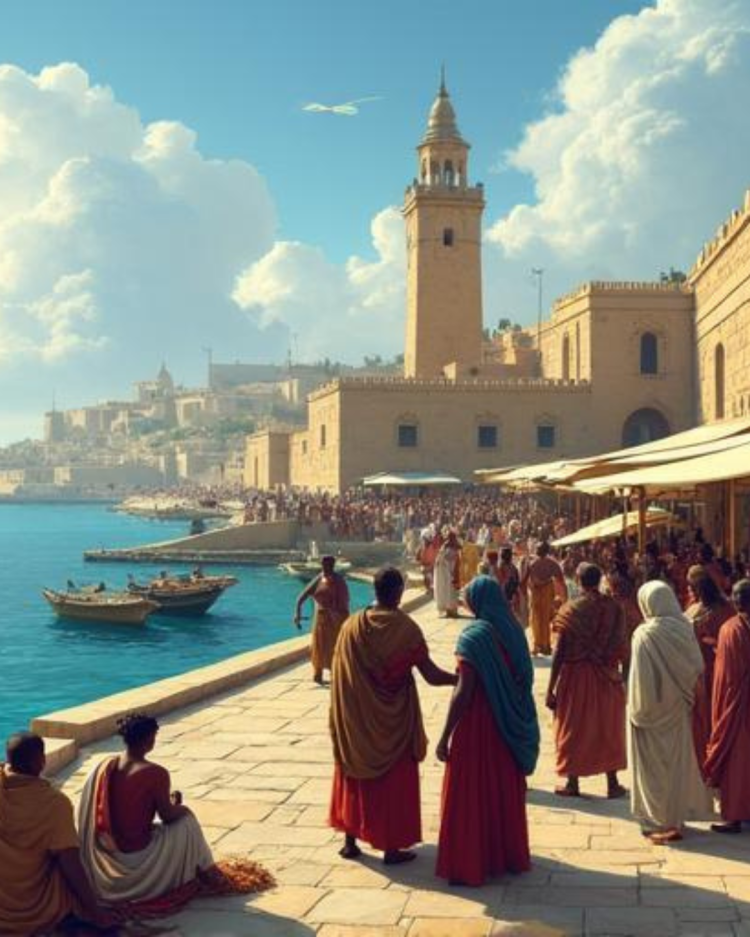
The journey to Egypt made by Mary and Joseph is often imagined as a flight into obscurity, a way of avoiding notice. But the story itself suggests something different. They do not flee to Egypt to disappear. They flee there to be received —to be loved, seen and heard.
Egypt: Alexander’s City — a place where the dawn meets the sun
In Bethlehem, Mary and Joseph are received and given accommodation in a cave — a place some describe as a barn, ill equipped to provide true hospitality. Here, as visitors from the East arrive in the first light of dawn, following a star, they bestow gifts to celebrate the birth of a Holy Man, a Holy Family, as foretold in the Law, the Prophets and the Psalms.
Yet news of this Holy Family — birthed into the world as God’s only begotten — disturbs the status quo. Scripture tells us that when word of a Holy Man, vulnerable as a newborn child, reaches Herod’s ears, he orders — or legally permits, through laws already in place — the killing of all newborns under the age of two. This killing of the innocents was likely carried out by exposure, a common fate experienced by unwanted babies in many cultures at that time, and since.
In Jewish culture, the family — rather than the individual — is the smallest human nucleus. The family therefore begins on the day of the wedding, witnessed and conducted by the rabbi. (see Marc-Alain Ouaknin, Symbols of Judaism, Assouline Publishing, New York, 2000).
In Egypt, the Holy Son goes swiftly into the East — into a world where story, song, and memory are already ancient, where faith is carried not only in texts, but in music, movement, and shared imagination.
So why Alexandria? Why would the Holy Family hurry toward a city — or a place named for a Greek called Alexandros, and not some other place in Egypt?
Perhaps here, what was new would have been recognized as old. A newborn love, coming alive according to prophecy, would have been embraced as an ancient man-child — welcomed, encouraged, and drawn into conversation. This love would have been lifted up by elders who knew how to carry truth in story, and by age-old friends who understood how love grows strong through walking, talking, and shared life.
In this way shared life, an ancient love coming alive would have become a mirror, as if catching the light of the sun to illuminate what had long been planted in the human heart. As this love was shared, it would dwell among a community capable of providing the hospitality such ancient love needed.
Scripture provides glimpses of truth that support the notion that the Holy Family, after the wedding in Joseph’s hometown, went to Alexander’s city — place. Granted, Alexander’s place may not have been the famous city on the Delta. What matters here is not geography alone, but what such a place represents for the faith journey.
The story told in Acts 18 names Alexander’s place as the place of the nativity of Apollos. Granted, the name Apollos recorded in Acts and in the Pauline Letters may not originally have included the final “s.” Nevertheless, the name Apollos — as recorded in Acts 18:28 — means “of Apollo.”
According to widely available historical accounts, political propaganda placed the head of Alexander on one side of a copper coin, with the head of Apollo on the other. In this way, Alexander’s victories were rendered sacred—for he was deified as Apollo, the one who brought Nikē to the dēmos, to the people. This imagery circulated prior to Rome’s rise to power, serving to keep peace when necessary through military strength amid competing Greek, Roman and Arab states.
For those well acquainted with the Gospel story that places the Baptist’s head on a copper plate, it becomes possible to see why early Christians might have linked John the Baptist with Apollos.
This linking of Apollos as a native of Alexandros’ place or city may also have sparked the Pauline question and answer: What then is Apollos? What then is Paul? but servants. (1 Corinthians 3:5).
Further to the scriptural claim that Alexander’s place was the nativity, the birth place of Apollos is the description of Apollos as a learned man who knew only that of John the Baptist. Curious to this little seed of information is the fact that the Pauline author’s question and answer — What is Apollos? What is Paul? but a servant — is joined to the claim that Apollos waters the seeds of the Gospel planted by said author.
Now many will protest, saying but the Pauline author never met Mary or Joseph, let alone the child brought to Bethlehem, the place of Christ’s Nativity, begotten from Mary’s womb.
Yet, Alexandros’ place — whether the famous city of Alexandria or another place bearing Alexandros’ name where the Dawn meets the Sun — the fact remains: the fruit of Mary’s womb, the seed of her womb, needed a place where what was planted in the dawn could thrive in sunlight.
Two further details need to be added so that the watered seeds of Apolline and Pauline cultivation are seen to germinate with God the Father —who supplies the increase. Additional servants are necessary, one being Joseph who accompanied the Pauline author to the Greek and Roman cities of Lystra and Derbe. For Joseph’s name means “he will add” or “the one who brings the increase.”
The second detail adds further light brought in by the Lukan author of Acts who testifies that the Pauline author bore witness to the Jews that Jesus was Christ (Acts 18:5). The same account adds that Apollos vigorously refuted the Jews in public debate, proving from the Scriptures that Jesus was the Christ (Acts 18:28).
The Greek Interlinear text adds still more light here. It presents the Pauline author as bearing witness —to the Jews “to be” the Christ Jesus—who the prophet Isaiah identifies as the suffering servant (52:13 —53:12).
While the Pauline author is doing this, in the same chapter of Acts, Apollos is also proving “to be” the Christ Jesus — in keeping with Hebrews 6:19-20 which identifies the Forerunner as Jesus.
Too much light can be blinding and crippling, especially for those who have been born and kept in the dark.
This is the first in a series of Epiphany reflections. In the next post, I turn to the healing of the man crippled from birth.
If you would like to receive the next blog post, you are welcome to subscribe here.
Christmas hymns such as We Three Kings — with lyrics such as “Star of Wonder, Star of Night” — have long shaped the Christian imagination.
O star of wonder, star of night, star with royal beauty bright, westward leading, still proceeding, guide us to thy perfect light.
Children’s songs such as Twinkle, Twinkle, Little Star, and even the familiar wishing rhyme — Star Light, Star Bright, First StarI see Tonight… — invite wonder and trust.
Through song and rhyme, children — and adults — are encouraged to look up, to hope, and to trust in God’s guiding presence and messianic promise.
Like The Twelve Days of Christmas, these simple songs carry more than sentiment. They help people remember a journey — not of one Magus, but three — watching, travelling, and bearing gifts to help birth and sustain a Divine Kingdom on earth. A Kingdom envisioned by St. John the Divine as the Holy City, radiant with light (Revelation 21:1).
With that in mind, here are a few star-facts drawn directly from the Bible — not as fantasy, but as patterned meaning.
Esther, whose name means Star, saved her people not through force, but through wisdom, timing, and restraint. By keeping her Jewish identity hidden, she exposed Haman’s murderous plan at a banquet, turning the fate of her people at the appointed moment.
Although Esther’s story is told many generations after the Flood, it carries the same mathematical and theological pattern found in Genesis: six days of action that rest upon — and depend upon — the timing of the seventh. At the climax of Esther’s story, Scripture says the Jews obtained rest. The Hebrew word for rest, נוֹחַ (nuach), is pronounced Noah. This is not coincidence. It is God’s reliable pattern.
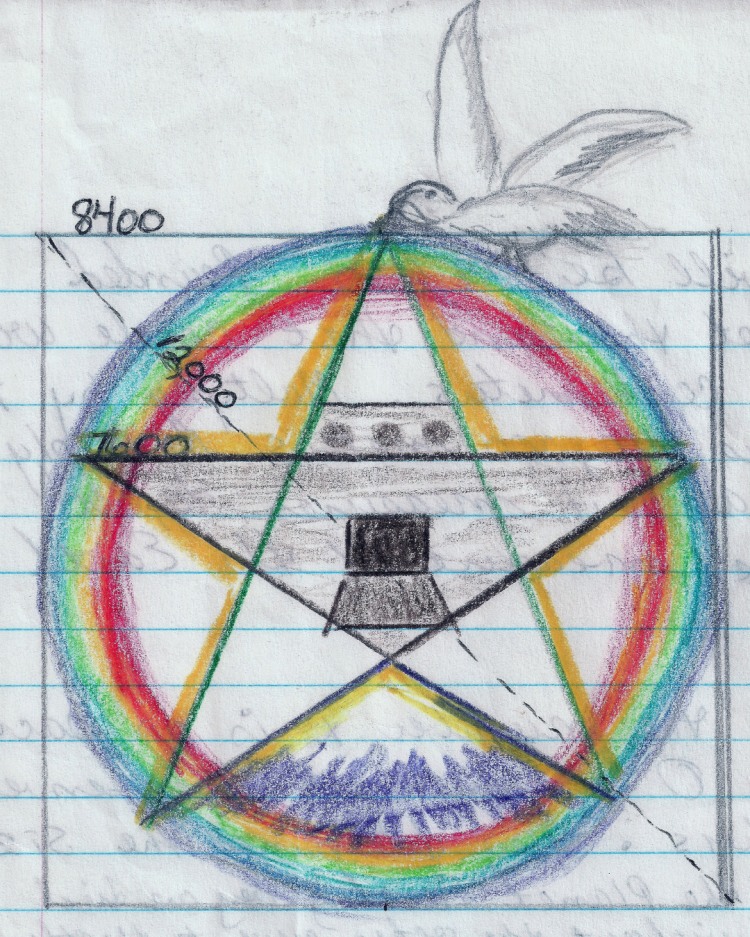
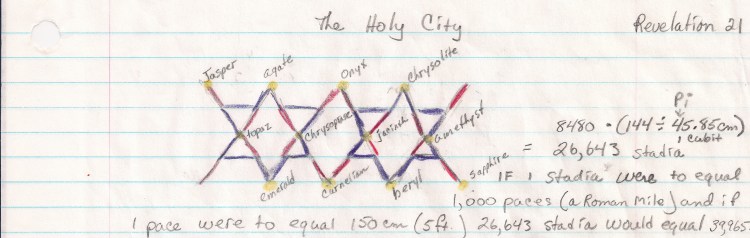
A hand-drawn diagram exploring Noah’s Ark, mountain imagery, and biblical geometry as expressions of covenant and divine promise.
For readers who wish to explore this pattern more deeply, a full mathematical and theological reflection is available in my paper The Mathematics of the Holy City which examines biblical geometry, timing, and light in relation to Scripture and Revelation.
A Hidden Identity in Plain Sight
In the New Testament, the Pauline author writes, “I have been crucified with Christ; it is no longer I who live, but Christ who lives in me” (Galatians 2:20).
What is often missed is how this author’s female identity was hidden in plain sight in the ancient world, not only through male grammatical convention, but through the biblical mystery of marriage itself — where two become one new man, a phrase the Pauline author uses deliberately to describe male-female unity through covenant, a mystery said to refer ultimately to Christ and his Bride (Ephesians 5:31–33).
This same mystery is affirmed by the Forerunner called John in the Johannine community, who insists that Christ is the Bride, belonging with and to the Bridegroom (John 3:28–29). In the book of Acts, when Paul speaks publicly in Greek cities, the crowds hear a heavenly messenger…travelling and speaking with Barnabas’ encouragement.
In Acts 14, the crowd names Barnabas Zeus, and Paul Hermes (the chief speaker) —the Roman equivalents being Jupiter and Mercury—as if thunder and his lightning swift messenger were walking among them in human flesh.
In the first century, Mercury the smallest planet was seen as a twinkling star — small, swift as lightning, appearing at dawn and dusk.
Jupiter, by contrast, shone steadily and brilliantly — the largest planet and most authoritative light when rising in the night sky —protecting the planets from comets.
Lightning and Thunder: ascending the holy mountain, Moses spoke with God, and God answered him with thunder, amid smoke and fire caused by the Lightning (Exodus 19:16-19).
The first to wrestle with that question were not one Magus, but three.
The Magi caught sight of the Star of David and began to watch—pondering, wondering, and attending as she travelled, lighting the world in a way they recognized. What drew them was not spectacle, but resonance: the way this Star spoke to them and to the prophets of old.
December 25 marks the beginning of Christmas — not its end.
The Church has always understood this season as a journey toward Epiphany — a learning to see by the light. Epiphany marks a turning —a slow movement from birth toward receiving the gifts of not one Magus, but three.
They do not arrive as ordinary rulers. Their authority is shared, received in relationship. Watching the Star of David light up heaven and earth, they don kingly cloaks as witnesses —bearing gifts to birth a Kingdom older than empire and newer than dawn.
Epiphany is not for staying comfortable. If you are willing to leave the cradle and step into the cold water of baptism, I invite you to listen to my recorded reflection on The Twelve Days of Christmas —a teaching song once used to form Christian faith when belief required courage, memory, and witness.
What if Saint Nicholas, Santa Claus, Krampus — even Cinderella — were carrying a forgotten Gospel story?
Seventeenth-century art holds key Gospel clues — insights modern theology often overlooks.
This Advent, I’ve released a Christmas video that uncovers clues placed in plain view in old art, folklore, and Scripture — yet overlooked for generations. These clues reveal a deeper story — one that reconnects Nicodemus, Moses, the Well-born Woman, Thunder, and the long-forgotten companions of Saint Nick.
What This Year’s Video Reveals
In my 2025 Advent reflection, I explore how Europe’s Saint Nicholas traditions preserved fragments of an older Gospel memory — clues that survived in paintings, stories, and Christmas rituals long after their original meaning was forgotten. When I first encountered several 17th-century Dutch paintings, I had to rub my eyes: was the artist deliberately pointing to Cinderella, to Simon the Magus, and to a hidden Gospel drama using nothing more than a leather shoe and two parrots —one grey, one green? These images opened the door to a deeper story — one that reshapes how we understand Saint Nicholas, Thunder, Barnabas, and the Nativity itself.
Previously for Christmas 2023, I revealed how Early Christians linked Joseph to Thunder and how he became known as Barnabas — the Barn Father.
Where manger meets Cross: the Child of God, Eternal Love’s gift.
Where the Story Goes Next
This year’s video builds on that foundation of Joseph the Barn Father — weaving together Saint Nicholas, Krampus, Cinderella, Nicodemus, Moses, and the Well-born Woman in a way that reveals the Gospel hidden beneath centuries of art and folklore. The more I followed these visual breadcrumbs, the clearer it became: the Nativity story Early Christians preserved was richer, deeper, and far more interconnected than most of us were ever taught.
As my previous 2023 Advent video uncovered Joseph as Barnabas — the Barn Father (Acts 14:12), thus this year’s reflection reveals why early believers also associated Thunder with Joseph… and why the lantern-bearing figure in so many Nativity scenes was not merely symbolic, but theological.
The result is a pair of Christmas reflections — 2023 and 2025 — that speak to one another like two sides of a single coin.
Watch the Videos
To make viewing easy, I’ve placed both Christmas reflections together on my website: 👉 Watch the Christmas videos here:https://lindavogtturner.ca/videos
The 2023 Video: explores Joseph as Thunder, the Barn Father, and the meaning of the manger in light of ancient traditions.
The 2025 Video: uncovers the forgotten companions of Saint Nicholas, the hidden Gospel clues in Dutch art, and how Cinderella and Simon the Magus echo an older Christian memory.
As Advent unfolds, I hope these reflections remind you that Christ has always found a way to speak — through prophets and shepherds, through art and tradition, and through the stories handed down to new and old hands following Christ’s birth into this world. None of these witnesses are accidental. They invite us to listen again, to see again, to believe again.
Whether you watch one video or both, may they stir something deep within you: a renewed hunger for truth, a curiosity for solving mystery, and a fresh confidence in the eternal life Christ came to reveal — the life breathed by the divine Pair, Thunder and Lightning, who from the beginning have given life to the Son of Man… so that all may be born again.
Most people know the Bible begins with, “In the beginning…” but far fewer have paused to notice the Third Day.
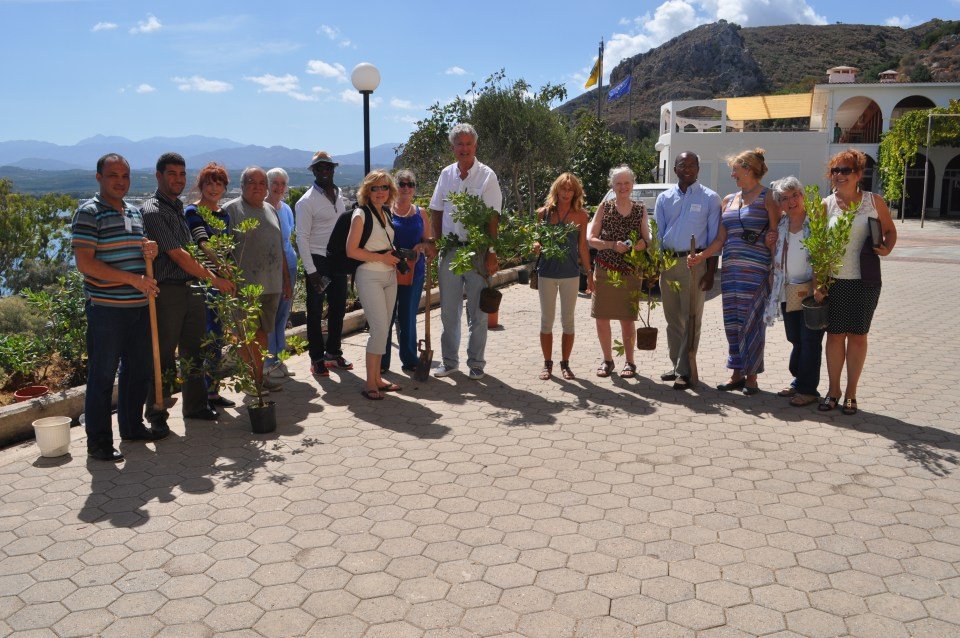
Planting trees speaks to the Third Day of Creation — when God spoke, bringing the land, seas, and trees to life.
On the Third Day of Genesis, God spoke and established the land, the seas, the plants, and the trees — the foundation of life itself.
On another Third Day, long after Genesis was written, something else happened in a garden.
On the third day after Jesus was nailed to a tree and then taken down from the tree and buried, the Woman Jesus called Mary the Magdalene came looking and watching for the promised Bridegroom, the Rabbi called the Forerunner had testified about. The Tomb in a Garden of tombs was empty except for two angels in white sitting where the body of Jesus had lain, one at the head and the other at the feet.
Those guarding this Tomb down through the centuries have said. “What kind of ‘fake news’ is this?”
There is some truth to that question, suggesting that this story is fake, not quite what one assumes when one first looks into the tomb the guards are watching over.
Joseph and the Teacher of Israel both wrapped the body of Jesus in clean linen sheets and buried the body, within a stone cavernous body of Joseph’s making. Scripture records how the Woman Jesus called Mary Magdalene — and the Mother of Joseph — knew where the body of Jesus lay. But don’t be fooled by the title Mother because the Mother belonging to Joseph would be the Woman chosen to be the Mother of his children.
Did not the Baptist say he was not the Christ his disciples were watching and waiting for because the Bride belonged to the Bridegroom — John 3:28-29.
Are you listening thinking like Simon the Cyrenaic (man of worldly thinking)? Simon was chosen by Jesus as the Building Stone of the Church, tradition claims is the Bride who belongs to the Bridegroom.
Yet Simon — Peter, the Rock — balked when Jesus declared that the path led to Jerusalem, led to suffering, to death, and to rising on the Third Day.
Simon very adamently told Jesus that this would never happen and even called Jesus, Lord!
Peter took Him aside and began to rebuke Him. “Far be it from You, Lord!” he said. “This shall never happen to You!”
Now you may be hearing the wordsHim and Lord and thinking: Clearly. Jesus is Male. “He who has ears to hear, let him hear.”Don’t let Patriarchal Language keep you in the dark.
Simon is in truth, rebuking the Woman Jesus — the one who had just chosen him to be the Father of a godly family. His words drip with sarcasm. He mocks her for daring to think that she, a woman, could claim such authority for herself and for him.
Suicide! he thinks. They plan to kill her.Does she not understand?
Yet the Woman Jesus trusted the word of her sister Martha’s Lord, who once said:
“Mary has chosen the good portion and will not be taken from her”—Luke 10: 42.
In Greek, the word “portion” is meris — not just a fragment, but a meritorious share, and inheritance that endures. That inheritance is what the Woman Jesus claimed, even as Simon mocked her.
Then the Woman Jesus turned and said to Simon the Cyrenaic — the Black Rock:
“Get behind Me, Satan! You are a stumbling block to Me. For you do not have in mind the things of God, but the things of men.” —Matthew 16:23
Yet Jesus the Woman did not leave the matter there, but added:
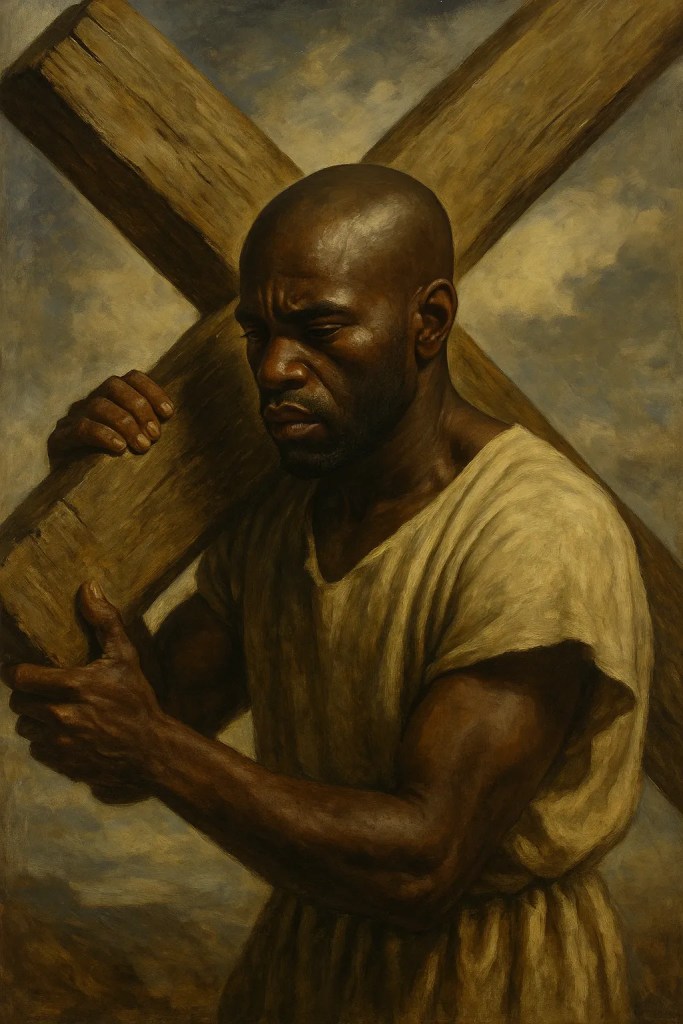
“If anyone would come after Me, let him deny himself and take up his cross and follow Me. For whoever wants to save his life will lose it, but whoever loses his life for My sake will find it” —Matthew 16:24–25.
Later, what appears to be another Simon is named — Simon of Cyrene (Mark 15:21). The word Cyrenaic carries a double meaning: not only a man from Cyrene, but also a hedonist, one who seeks pleasure and avoids suffering. In this light, Simon the Cyrenaic truly was “thinking as men do,” worldly and unwilling to accept the Woman’s call.
Yet the mystery deepens: it is this same Simon who is compelled to take up the Cross. The Black Rock, once resistant, becomes the very one who shows what Jesus had promised — that in denying worldly pleasure, in taking up the Cross, one finds life on the Third Day.
Joseph of Kyrenia, called Barnabas and honoured as Jupiter, was seen as the earthly father. Simon of Cyrene, remembered as Simon the Black, carried the Cross as the heavenly Father incarnate. But worldly thinking divides his robe and identity.
Joseph and Simon are not two but one — the Everlasting Father whom the world calls by many names.
Jupiter was named the God of Thunder, and it is Thunder and Lightning that bring fire and cause the mountain to shake on the Third Day. This is the heart — and the cause — of the Third Day.
For the Third Day fulfills the Word of God, bringing back to life the Jesus whom worldly thinking seeks to silence — nailed to a tree uprooted from her roots — yet bestowing eternal life to those in the tombs.
The Orthodox Church sings this truth each week in the Hymn of the Resurrection:
Christ is risen from the dead, trampling down death by death, and on those in the tombs bestowing life!
The hymn is not just a song of triumph — it is a declaration of hope in God’s power, which sweeps away false beliefs and fills humanity with incomparable hope.
Do we believe it? Or do we stumble at the very idea of taking up a Cross? Do we reduce it to soldiers and temple police nailing people to beams of wood? Or do we see the essence — the fragrance — of the Cross? For in dying to the world’s way of thinking, the breath of resurrection is given, bestowing eternal life on the Third Day — John 20:22.
Do dead people come out of their tombs and walk and talk and teach others? Scripture says yes.
Peter and John stood in front of the Gate called Beautiful and said to those crippled by worldly thinking:
“Look at us. Silver or gold I do not have, but what I have I give you: In the name of Jesus Christ of Nazareth, get up and walk!” —Acts 3:6
What caused Peter and John to stand there? What caused Peter to declare:
“Therefore let all Israel know with certainty that God has made this Jesus, whom you crucified, both Lord and Christ!”—Acts 2:36
John’s role is often overlooked. Many still see him only as the Baptist who lost his head in prison. But John is also Jesus the Forerunner — Hebrews 6:19–20 — the Prince of Peace foreshadowed in Isaiah 9:6. Thus, with Peter — Christ the Everlasting Father, the Bridegroom of the Mother of God — John stands reconciled to him, not merely as a companion but as the right hand, the trusted friend, the one through whom victory is given to the people (Niko–demos).
The mystery is revealed when Jesus breathed out on the Cross, saying:
“Father, into your hands I commit my spirit.”
The Spirit entrusted is not lost, but received — into the Father’s hands, and into the hands of those chosen to guard both Gate and Tomb.
John, the Forerunner, stands as the friend of the Bridegroom; with Peter — who, having now declared his love for Jesus, becomes Christ the Everlasting Father.
Together Peter and John guard the Gate called Beautiful, bringing victory to the people.
In the mystery of the Third Day, John too comes alive again — as Moses, as Nicodemus, as the Teacher of Israel who prepared the people in the wilderness to meet God.
This Teacher knows the voice of God in thunder, and he knows that God’s eternal partner is lightning — lightning that can kindle wildfires, strike coal seams alive with fire, and keep the earth in electrical balance.
So do we stumble when Jesus says, “Take up your cross”? Do we reduce it to soldiers and temple police nailing people to beams of wood? Or do we hear what Moses heard at the bush that burned but was not consumed?
What if we turned back and listened to the Teacher of Israel?
He was the one who first heard the voice from the Burning Bush on the Mountain of the Lord — the bush aflame yet not consumed. At first, he felt unqualified to speak. He had killed a man. Yet he answered the call. He brought the Israelites out of Egypt, and for forty years in the wilderness he prepared them to meet God on the Third Day.
And how would he prepare them/us? With the Genesis Creation Story?
So turn with him, turn with me, back to the beginning. On the Third Day, God spoke — and the seas, the plants, and the trees came into existence. Think about this: God’s speaking breathed out carbon dioxide. Carbon dioxide is a form of carbon. And carbon is the building stone of all life. Without carbon, nothing on earth would be alive.
Thus, in Genesis, in the account of the Third Day, Moses the Teacher of Israel made an extraordinary observation: that the very element which holds life together — the same element many today see only as a threat — is the sign of God’s creative voice.
The Teacher told the people of Israel, and all who followed him out of Egypt, how God’s energy hovered over a dark, watery abyss and brought forth sound and light — together like an eternal couple, thunder and lightning. And out of that union the world was set in place, resting on a framework of seven days and seven nights of 1200 hours — sealed with the promise of the ark’s rainbow —and from the Mountain of the Lord, the rainbow can be seen as a perfect circle, an eternal covenant.
In the beginning, the earth was formed within a framework of seven days. Carbon — the building block of life — was woven into every molecule. Lightning split the skies, and thunder answered, releasing nitrogen, the fertilizer of creation. Yet worldly thinking mocks and dismisses this holy measure.
First Day: God Spoke saying let there be Light and then God called the Light Day and the Dark Night.
Second Day: God Spoke again and established the Sky and the Sea.
Third Day: Dry land, seas, plants, and trees were created.
Fourth Day: The Sun, Moon, and stars were created to mark seasons, days, and years.
Fifth Day: Sea and flying creatures were created.
Sixth Day: Land animals and humans were created.
Seventh Day:God blessed it and made it holy — the framework of time, a measure of the earth, given as blessing.
God’s First Ecumenical Environmental Charter: The Ark
The story of Noah’s Ark is often reduced to the image of a big wooden boat. But the deeper truth hidden in the measurements is that the Ark was never just a boat — it is a symbol of the whole inhabited earth.
In the days of Noah they were eating and drinking, marrying and giving in marriage, ignoring the thunder and lightning. The flood came, and the Ark — a worldly barn of creation’s pairs, pulled together like carbon with oxygen, like gravity with love — was prepared and saved, thanks to Noah.
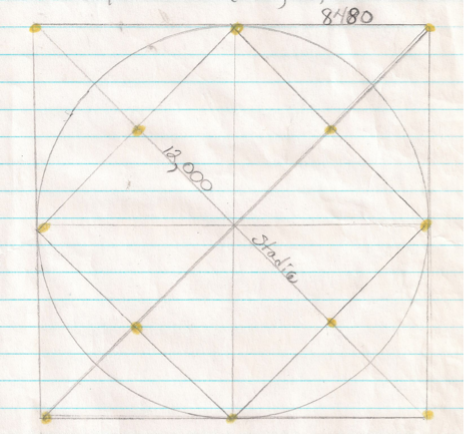
Genesis 6:15 gives the Ark’s dimensions: 300 cubits long, 50 cubits wide, and 30 cubits high. Instead of treating these as separate numbers, I added the breadth and height to the length, arriving at 380. Using the larger cubit of about 20 inches, the result was 7,600 inches. This number became the key to drawing not only the Ark, but also the hexagram and pentagram that frame it — resting on the mountain peaks, joined by the olive twig, and sealed with the rainbow of God’s covenant.
When I drew a square around the rainbow, the diagonal measured 12, and the circle’s diameter came to 8.4. What emerged was astonishing: by reworking the Ark’s measurements through simple arithmetic, the story points us toward the actual circumference of the earth. The Ark, like creation itself, carries within it the measure of the world — about 40,000 kilometers.
Even pi, that number we’re told the ancients didn’t have, is woven into the text. Dividing 144 by a cubit of 45.72 cm yields 3.14. The numbers are there for anyone with eyes to see.
This is why I call the Ark God’s first ecumenical environmental charter. It is not a children’s fable about animals in a boat; it is a revelation that creation is measured, balanced, and preserved within the covenant of God. The rainbow is the sign of this covenant — not only with Noah, but with every living creature.
The storm was over, the sun broke through, and from heaven’s teardrops the rainbow gleamed — as a friend’s sunny smile brings a promise of hope. Was this just coincidence? Or was it a foreshadow of the Third Day, when the Woman Jesus called the Magdalene — the promised Light of the World — shed her tears in the presence of the Teacher in the Garden?
Exodus 19: The Mountain Shakes and the Teacher of Israel is called to Ascend
Long before Israel stood at Sinai, people of every culture watched the skies and tried to understand the powers above them. The Egyptians worshipped the Sun as the supreme creator. The Greeks and Romans saw Jupiter, the storm-god with his swirling red spot larger than earth, as the Father of the gods.
Modern science now tells us that the Sun and Jupiter were formed together from the collapse of the same primordial cloud. Jupiter’s massive gravity still acts as a gatekeeper, deflecting many comets and asteroids from striking earth — though not all. This “gatekeeping” echoes Simon Peter’s role in the Kingdom of God.
“And I tell you that you are Peter, and on this rock I will build My church, and the gates of Hades will not prevail against it. I will give you the keys of the kingdom of heaven.”
More Science also tells us that lightning and thunder are born of energy building within a dark, watery abyss. A bolt of lightning superheats the air until it explodes; the shockwave becomes thunder. Lightning strikes can ignite trees; even coal can roar like thunder when struck by lightning on the surface or at mine entrances.
Thunder may not seem to serve a purpose beyond warning us, yet without it the earth would lose its electrical balance in minutes. Thunderstorms replenish what the constant flow of electrons drains away; without them, creation itself would unravel.
All of this becomes a backdrop for Sinai. On the festival of the Third Day, the Teacher of Israel — Moses, as the Egyptians had named him — brought the people to the mountain where he had first seen the bush ablaze but not consumed.
The mountain itself was wrapped in smoke and fire. Lightning flashed. Thunder roared. The blast of the ram’s horn grew louder and louder, and the whole mountain shook violently — Exodus 19:16–18.
And yet — while the people trembled below — Lightning flashed again, and Thunder answered. Moses was called upward. He ascended. He stepped into the thundercloud with lightning flashing, to speak with God, and God answered him in the thunder — Exodus 19:19–20.
You might think Moses was a brave man. But this was not the first time he had ascended Sinai. Before he was called to go and liberate the Hebrew people from the idolatry practiced by the Pharaohs in Egypt, he had already encountered God in the bush that burned but was not consumed. Orthodox Christians call this the Unburnt Bush and claim it is the Icon of the Mother of God, while her Son is the Power and the Father the Most High.
Six chapters later, after speaking with God and hearing Him answer in Thunder, Moses is once again on Mount Sinai. This time, the Lord instructs the Teacher of Israel to hammer a golden lamp from a single unit of gold, in the pattern of a blooming almond bush, with a main shaft and six branches. This Lamp Stand was to be set apart as Holy, and kept lit day and night with olive oil furnished by the priests serving in the Holy Place of the Tabernacle — between the Holy of Holies and the Court of the Gentiles where Jesus taught —Exodus 25:31–40.
For the Hebrew people, the Golden Lamp Stand symbolized the Tree of Life in the Garden of Eden; for Christians it foreshadowed Jesus as the Light of the World. In Greek, this almond-branched tree is the Amygdala — hammered from the most precious metal to manifest God’s eternal presence and the Hope found in trusting that God is watching to ensure His Word is accomplished —Jeremiah 1:11; Isaiah 11:1.
Yet the disciples did not understand what Jesus meant by the Third Day. They assumed it meant He would be silenced as all dissidents were: imprisoned and executed according to political custom. Under Roman rule, that meant being nailed to wooden beams — trees cut and fashioned into crosses to display defiance crushed. Crucifixion was seen as the ultimate sacrifice that inspires courage. But is that Godly thinking? Or is it still worldly thinking that silences Jesus and keeps Him from rising — from ascending — on the Third Day?
Simon thought like a man, not like God, when he refused to believe that Jesus must go to Jerusalem, be tested by the priests and scribes, and be put to death on the Third Day.
Now on the Third Day, the Woman Jesus — the Almond Tree, the Amygdala — lay wrapped in the linen of Nicodemus and Joseph, buried in the cavern of their stony hearts. They had desired her and kept their love for her a secret, but now they shut her out, as if they knew her not. Yet when the stoney heart of Joseph’s making was shaken by angels and shepherds, the secreted love of these two men became more evident — except to the Woman Jesus called the Magdalene, when two angels told her that Jesus of Nazareth was no longer buried.
In tears, the Woman Jesus humbled herself and approached the Teacher in the garden of tombs, supposing she had been wrong about Peter, the one she had chosen. Seeing the Teacher watching over the Garden, she supposed he was the husbandman who had taken her Bridegroom’s place. But as she turned at the sound of his voice, and he said:
“Do not cling to me, for I have not ascended to the Father.”
She hears Joshua’s voice echoing to Israel when they were about to enter the promised land:
“Cling to the Lord as you have always done to this day.”
Her empty heart and soul began to fill with joyful expectation. She realized she was going to raise a divine familyand establish a new covenant. Her Husbandman was not dead, sitting on a throne in the sky. He was down by sea, a little shaken — trying to stand after a long night in the dark, and walk the talk on ankles strong enough to bring her out of the sea as the Tangled Catch of the Day.
The Heart of the Third Day
Now as the Creation Story, the Resurrection Story, and the Second Coming are mocked and dismissed as Fake News, I prepared this blog to invite you to turn back and listen to the Third Day ascension of the Teacher of Israel, the Egyptians named Moses.
The Third Day Ascension Event in Exodus demonstrates the Teacher of Israel’s power as the Son of God, born again and reconciled to God the Father with the Woman Jesus called the Magdalene — the I AM who is The Light of the World, the Gate, the Resurrection and the Life, the 153 Fish, the Womb of Life.
Peter, the Black Rock, is her Bridegroom — the one given the keys, whose love, whose gravity, like Jupiter’s, guards the covenant and keeps the gates of Hades from prevailing. And John, who kept watch under the cover of darkness, is Jesus the Forerunner who testifies that the Bride belongs to the Bridegroom — John 3:28–29.
Together Peter and John stand at the Gate called Beautiful, and Peter takes the lead, saying to those crippled by worldly thinking:
“Look at us. Silver or gold I do not have, but what I have I give you: in the name of Jesus Christ of Nazareth, rise and walk.” (Acts 3:6)
The city lies foursquare — its divider measures 144 cubits. Its diagonal stretches 12,000 stadia, with foundations adorned in every kind of precious stone. Yet if thunder and lightning storms ceased, there would be no life. This pair sustains the electrical balance and renews the earth as it does in heaven.
The keys are in Peter’s hands, offered to all. Yet only those sons and daughters with the power — with eyes to see and ears to hear — will take them. They will link arms with Jesus the Forerunner and walk the talk, honouring their Mother and their Father in Christ and receiving the promise: to live long in the land.
Micah 6:8
And what does the LORD require of you
but to act justly, to love mercy,
and to walk humbly with your God?
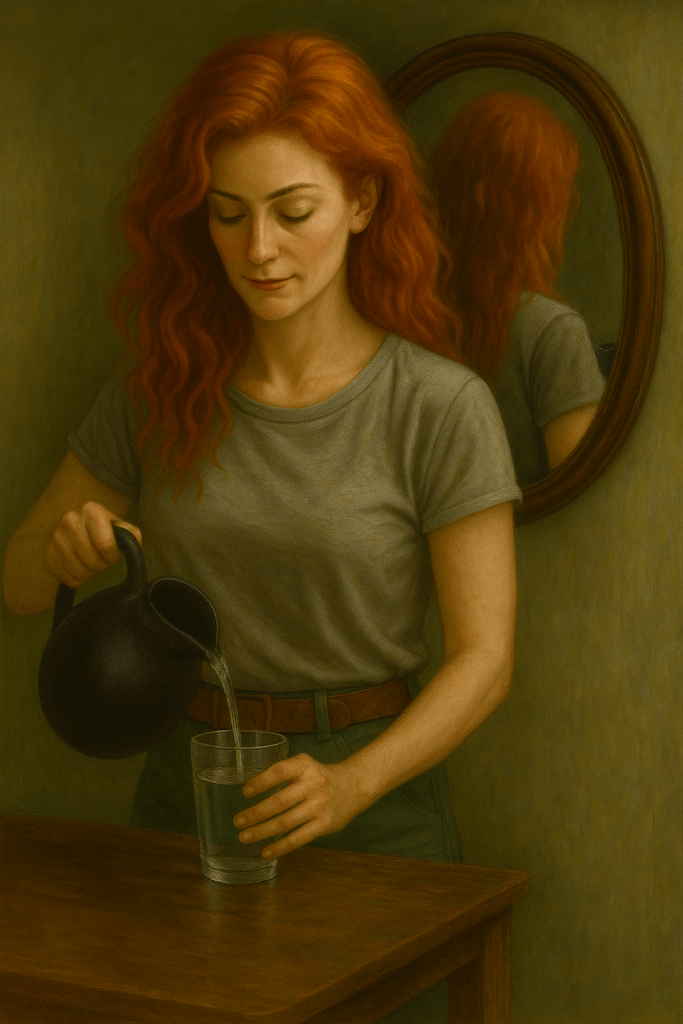
The Samaritan pours water, heeding the striking weight of Micah’s prophetic words, as the Rooster asks her for a drink.
The parable of the Good Samaritan has long been used to honour the Samaritan’s mercy and to encourage the laity to be kind to neighbours in need. Yet for centuries this story has also been used by theologians, priests, and ministers who have not fully understood it. Some have unwittingly kept the laity in the dark; others have deliberately politicized it to serve the world’s agenda. Secular values and ideologies have crept in to exploit the Samaritan’s mercy to keep people trapped in guilt, enabling sin rather than leading to repentance. Too often the Church has fed the milk of the Gospel without substance, to cater to new believers, forgetting that the parable calls us not only to show compassion, but to turn back and see God in fourfold harmony—Father, Mother, Teacher, and Grace.
The Parable challenges not only the Advocate, the expert in the law, and those standing and passing by, with the question: Who is my neighbour? It challenges all to heed the Lord’s requirement, anchored in the words of the prophet Micah:
"And what does the LORD require of you
but to act justly, to love mercy,
and to walk humbly with your God?" — Micah 6:8
The parable of the Good Samaritan is not a weapon to shame or a license for reckless giving that could endanger yourself or your neighbour. It is a mirror. In the priest, the Levite, the Samaritan, and the lawyer we see ourselves—and each one, in their weakness or their strength, as neighbour.
The Samaritan of five husbands, bound to one not true, longs for the One who will send her out justly, like a never-failing stream.
In reply Jesus said: A man was going down from Jerusalem to Jericho, when he was attacked by robbers. They stripped him of his clothes, beat him and went away, leaving him half dead.
A priest happened to be going down the same road, and when he saw the man, he passed by on the other side. So too, a Levite, when he came to the place and saw him, passed by on the other side.
But a Samaritan, as he traveled, came where the man was; and when he saw him, he took pity on him. He went to him and bandaged his wounds, pouring on oil and wine. Then he put the man on his own donkey, brought him to an inn and took care of him. The next day he took out two denarii and gave them to the innkeeper. “Look after him,” he said, “and when I return, I will reimburse you for any extra expense you may have.”
“Which of these three do you think was a neighbour to the man who fell into the hands of robbers?” The expert in the law replied, “The one who had mercy on him.” Jesus told him, “Go and do likewise.”
And who is that pitied man in the ditch — is it the Lord, the Rock? And is the Samaritan his Bride, the Advocate, who bathes his wounds with oil and wine?
The Samaritan, the Bride — holding the cup of suffering, wakes at the Rooster’s call. Yet the Lord does not seek pity.
Oh what love she bears for the Rooster, her neighbour and friend, who crows her awake. His priests and Levites stand beside him, reminding her: mercy must flow from a heart that is humble and just. She must not spend her purse to indulge dependence. She must walk humbly, wisely — and with grace.
For she is beloved — cherished by the Rooster, who is also friend to the Bridegroom. And the Bridegroom too must awaken: to remove her cup, to lift her stripes of suffering — if it be his will. For should he forsake her and tend only to himself and his purse, he will die alone.
For unless a single kernel of wheat falls to the ground and dies to singleness, it remains alone. But if a man in love dies to the single life, he will rise and don the wedding garment, ready to tend his Bride’s sheep.
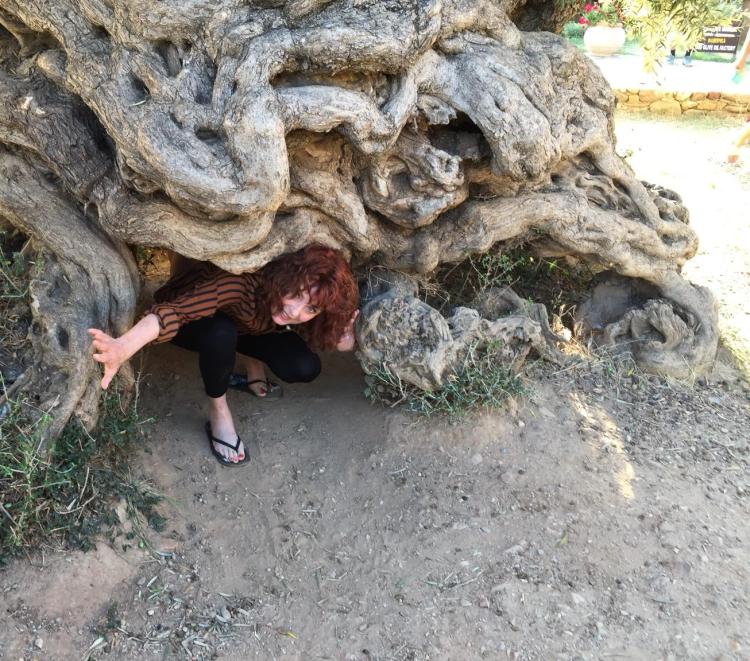
For the roots of covenant love run deeper than any single life — and like the ancient olive tree of Vouves in Crete, they bear witness across generations.
Emerging from ancient Grecian roots, the Bride wears the stripes of suffering, waiting for her Bridegroom to heed the Rooster’s voice and don his wedding garment. (Photo credit: Vouves, 2019, courtesy of Don Arthur Stewart, Vancouver BC — whose lens captured an iconic moment.)











 Linda Vogt Turner